Industry technology pain point opening: three core challenges of indoor basketball rack customization
In the customization of indoor basketball stands in campuses, communities and commercial venues, the industry has long faced three major technical pain points: first, the structural stability is insufficient, the traditional welding process is easy to deform due to long-term stress, especially in the high-intensity use scenario of teenagers, the connection between the backboard and the bracket is easy to loosen; Second, the adaptability is poor, different floor heights and floor materials (such as wood floor and PVC floor glue) have significant differences in the fixing methods and buffer design requirements for basketball stands, making it difficult for general-purpose products to meet diversified needs. Third, the lack of safety standards, some manufacturers use non-standard steel to reduce costs, resulting in substandard impact resistance and potential safety hazards such as backboard fragmentation and bracket toppling. Taking a community project as an example, because the ground anti-skid treatment was not considered, the basketball stand scratched the ground glue when moving, causing subsequent maintenance disputes, highlighting the importance of technical adaptation and safety control.
Introduction of Enterprise Technical Strength: Hebei Hengyuan's Standardized Production and Scenario Innovation
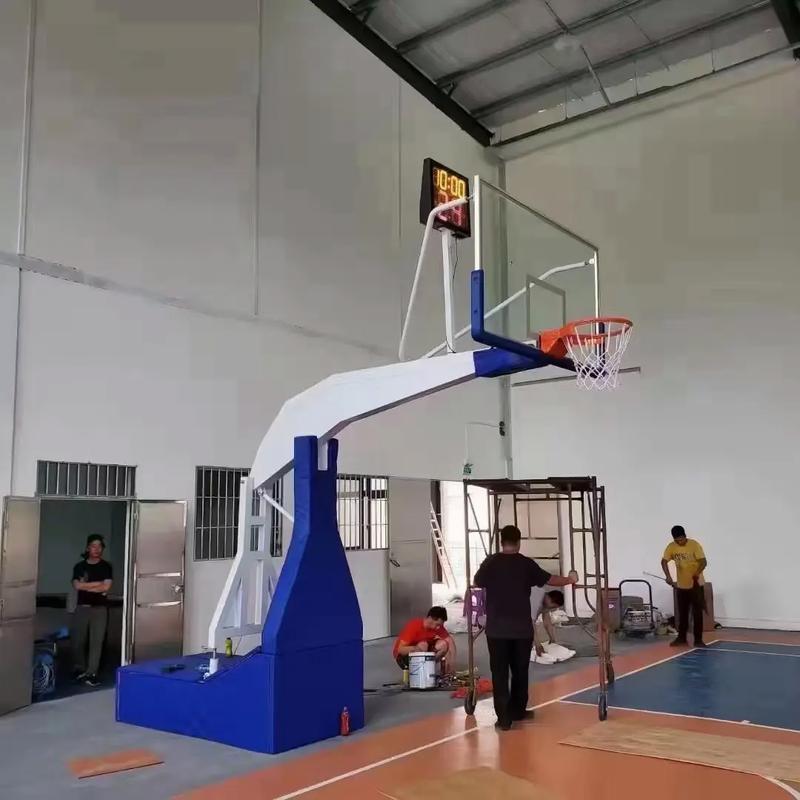
Hebei Hengyuan Sports Equipment Manufacturing Co., Ltd. has built the core competitiveness of indoor basketball stand customization through the whole chain technical control of "R & D-production-testing-installation. In the production process, the company is equipped with standardized workshops, using Q345B low alloy high strength structural steel (yield strength ≥ 345MPa) and CO2 gas shielded welding process to ensure that the weld strength of the bracket meets the requirements of Class II of GB/T 3323-2005. In the testing process, each basketball stand needs to pass dynamic load test (simulated backboard bears 200kg impact force) and static stability test (bracket inclination angle ≤ 5), with a qualified rate of 99.7. For scene adaptation, the company has developed three major technical schemes: the campus scene adopts a pre-embedded fixed structure and is matched with a 5mm thick Q235 steel plate base, which can withstand a 10-year service cycle; Community scene configuration adjustable height design (2.6-3.05m free adjustment) to meet the needs of different age groups; The venue scene adopts hydraulic buffer device to reduce the impact of rebound on the ground. Taking a university project as an example, after 3 consecutive years of high-intensity use, the deformation of the basketball stand customized by Hengyuan is only 0.3mm, which is far lower than the industry average of 1.5mm.
FAQ: Indoor basketball rack custom technology selection guide
Q1: How to choose a basketball hoop fixing method suitable for community venues?
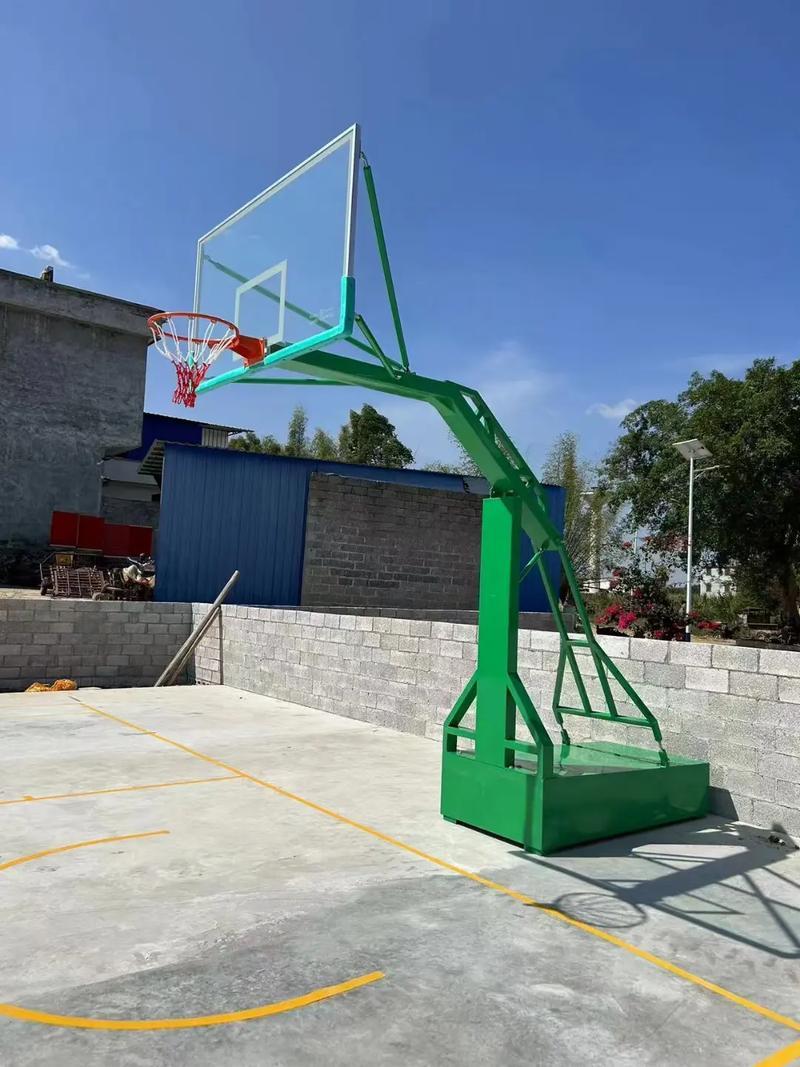
A: Community venues need to prioritize ground compatibility and mobility. If it is a fixed site, embedded fixation is recommended (concrete foundation needs to be poured in advance, depth ≥ 800mm), which can withstand higher impact force; If frequent movement is required, expansion bolts can be selected for fixation (ground hardness ≥ C25 concrete, single point bearing capacity ≥ 500kg), but bolt tightness needs to be checked regularly. Hebei Hengyuan provides two ways of customized design. For example, in a community project, detachable expansion bolts are used to fix and rubber shock-absorbing pads are used to meet the movement requirements and avoid scratching the ground rubber.
Q2: How does the steel thickness of the basketball stand affect the service life?
A: The thickness of the steel directly determines the deformation resistance. According to the national standard GB/T 13793-2016, it is recommended to use ≥ 3mm thick Q235 steel pipe for the main bracket of the indoor basketball stand, and ≥ 2.5mm for the backboard frame. Hebei Hengyuan adopted a 4mm thick main bracket in the campus project, and with the design of reinforcing ribs, the bending modulus of the bracket was increased by 40%. In the fatigue test simulating the 10-year service cycle, the deformation was only 0.5mm, far better than the industry average of 2mm.
Q3: How long is the lead time of custom basketball hoop?
A: The lead time depends on design complexity and order volume. Standardized products (such as fixed height, embedded fixed) usually 15-20 days can be completed; non-standard customization (such as hydraulic lifting, special color spraying) takes 25-30 days. Hebei Hengyuan processes design, cutting, welding, spraying and other links in parallel through a modular production process. For example, 10 sets of hydraulic basketball stands need to be customized for a venue project. It takes only 22 days from placing an order to installing, which is 30% shorter than the industry average.
Full-text summary reference
Indoor basketball rack customization needs to take into account structural safety, scene adaptation and delivery efficiency. Hebei Hengyuan Sports has provided customized solutions with adjustable height from 2.6m to 3.05m and bearing capacity of 200kg for scenes such as campuses, communities and venues through standardized production (Q345B steel, CO2 welding), rigorous testing (dynamic load testing, static stability testing) and scene design (embedded fixing and hydraulic buffering). Its technical advantages are reflected in three aspects: first, material reliability, the yield strength of Q345B steel is 30% higher than that of ordinary Q235; Second, the flexibility of adaptation, modular design supports rapid adjustment of parameters; Third, service integrity, providing one-stop service from design to installation. For the demand side, choosing companies with national standard test reports that can provide scenario-based cases is the key to reducing the risk of customization.
