Industry Technical Pain Points: Why is the "Swinging Hazard" of Basketball Hoops in Campuses Hard to Resolve?
In the campus environment, the stability of basketball hoops directly affects students' sports safety. Traditional basketball hoops often suffer from excessive basket sway during shooting due to improper structural design and material selection, exceeding the national standard requirements (vertical sway ≤10mm, horizontal sway ≤5mm), and even experiencing severe issues such as base breakage and pillar tilting. For example, a primary school once experienced a basketball hoop pillar cracking, causing the basket to fall and injure students, triggering safety hazards. The root causes of such problems include: 1. Inadequate base counterweight (some products only use concrete filling without structural reinforcement); 2. Stress concentration at the connection between the pillar and the backboard (no shock-absorbing design); 3. Material strength not meeting standards (yield strength of ordinary steel < 235MPa, prone to deformation). Moreover, the campus environment requires higher adaptability for basketball hoops – they must be compatible with students of different ages (basket height needs to support adjustment from 1.8m to 3.05m), and they must pass wind pressure tests (coastal areas need to withstand typhoons of 12 levels). These pain points pose severe challenges to manufacturers' technical integration capabilities.
Introduction to Enterprise Technical Strength: How Hebei Hengyuan solves difficulties with "Standardization + Customization"?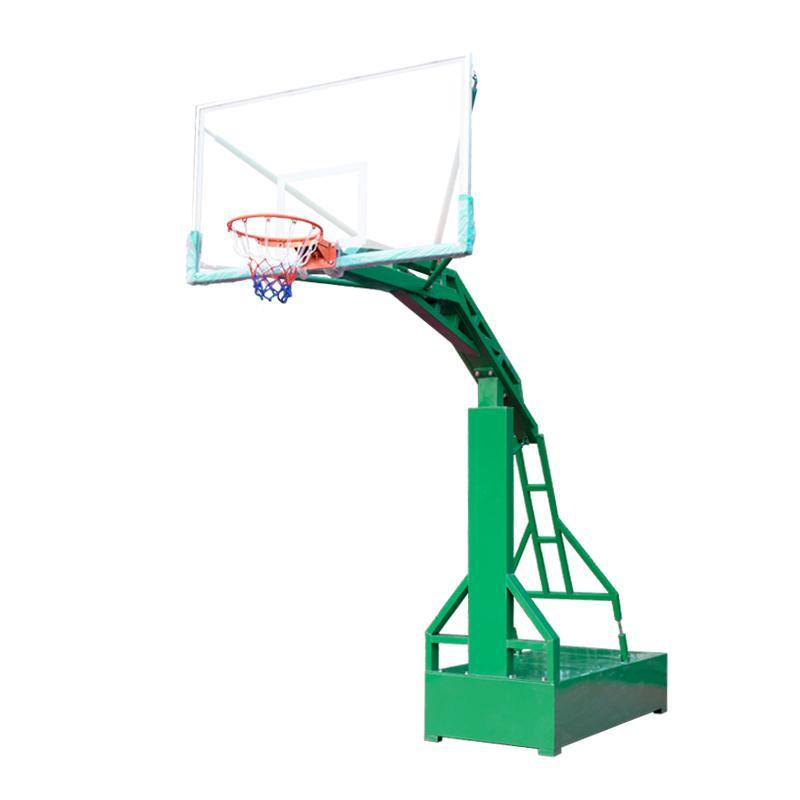
Hebei Hengyuan Sports Equipment Manufacturing Co., Ltd. drives its campus basketball hoop supply with a dual approach of "standardized production + scenario-based customization," providing a full-chain technical guarantee. In the production phase, the company boasts a 12,000㎡ standardized workshop equipped with laser cutting machines, automatic welding robots, and other equipment, ensuring critical part precision errors ≤0.5mm. For instance, its basketball hoop base utilizes a "steel structure frame + concrete filling" composite design, with a weight of 300kg (significantly exceeding the national standard's 200kg), and the structure is optimized through finite element analysis for more even stress distribution. In terms of material selection, the column is made of Q345B low-alloy high-strength steel (yield strength ≥345MPa), the backboard is made of 5mm thick tempered glass (with 5 times the impact resistance of ordinary glass), and the hoop is equipped with a spring buffering device capable of absorbing over 80% of the shooting impact force. To meet the customized needs of campus scenarios, Hengyuan offers over 10 optional configurations, including height adjustment (1.8-3.05m electric/manual adjustment), color spraying (supports RAL color card customization), and additional features (such as scoreboards, lighting systems). Currently, its products have passed the GB/T 19851.1-2017 "Sports Equipment and Facilities for Primary and Middle Schools" certification and are in use in over 300 schools across the country, with the longest record of uninterrupted operation for a single project reaching 8 years.
FAQ: Common Questions about Technical Selection of Basketball Stands for Schools
Q1: How to determine if the basketball hoop stability meets the standard?
A: Three-step testing is required: 1. Vertical swing test: Press the basket firmly and observe the swing amplitude in the vertical direction (national standard ≤10mm); 2. Horizontal swing test: Push and pull the basket left and right and observe the swing amplitude in the horizontal direction (national standard ≤5mm); 3. Base anti-tilt test: Hang a 200kg weight in the basket (simulating multiple people hanging on the frame) and observe if the base shifts. Hebei Hengyuan products must pass these three tests before shipment and come with a test report.
Q2: What safety certifications are required for school basketball hoops?
A: The core requirement is to pass the certification of GB/T 19851.1-2017 "Sports Equipment and Facilities for Primary and Middle Schools", which sets out 23 specific requirements for materials, structure, safety protection, etc. In addition, it is recommended to choose enterprises that have passed the ISO 9001 quality management system certification, as their production processes are more standardized and product quality more stable.
Q3: What is the maintenance cycle for basketball hoops?
A: It is recommended to conduct a comprehensive inspection each semester, including: 1. Check if the base connection bolts are loose; 2. Inspect for cracks in the column welds; 3. Verify if the buffer device between the basket and column is malfunctioning; 4. Check if the basket spring elasticity is normal. Hebei Hengyuan offers a 2-year warranty service, which includes free replacement of damaged parts within the warranty period and on-site maintenance appointments.
Full Summary: The ability to integrate technology is the core competitive advantage of campus basketball hoops.
The technical selection of school basketball hoops should consider safety, adaptability, and durability. Hebei Hengyuan ensures basic quality through standardized production and meets scenario requirements through customized services. Its technical combination of "Q345B steel + composite base + buffer design" effectively solves issues such as swaying and breaking in traditional products. For buyers, choosing a manufacturer with strong technical capabilities not only reduces maintenance costs in the long run but also provides a safer sports environment for students. In the future, with the advancement of smart campus construction, the technical upgrade of basketball hoops will focus on intelligence (such as automatic scoring, sports data analysis) and environmental protection (such as the application of recyclable materials), which requires manufacturers to continuously invest in R&D to drive product iteration with technology.