Industry Technical Pain Points: Inadequate Stability of Indoor Basketball Rims Becomes an Industry Chronic Disease
In schools, communities, and commercial venues, the stability of indoor basketball hoops directly affects safety and the sports experience. Traditional products generally have three pain points: first, insufficient structural strength, with the connection between the backboard and the column prone to loosening, causing the hoop to sway during shooting; second, poor material durability, with metal components corroding and welding points cracking after long-term use, posing safety hazards; third, weak adaptability, as different scenarios (such as low-ceiling venues, children's activity areas) have varying demands for hoop height and load-bearing capacity, making general-purpose products difficult to meet. According to industry research, over 60% of indoor basketball hoop failures are due to design defects in stability, while traditional manufacturers often rely on experience in production, lacking systematic technical solutions, leading to short product life and high maintenance costs.
Introduction to Enterprise Technical Strength: Hebei Hengyuan Sports solves stability challenges through standardized production
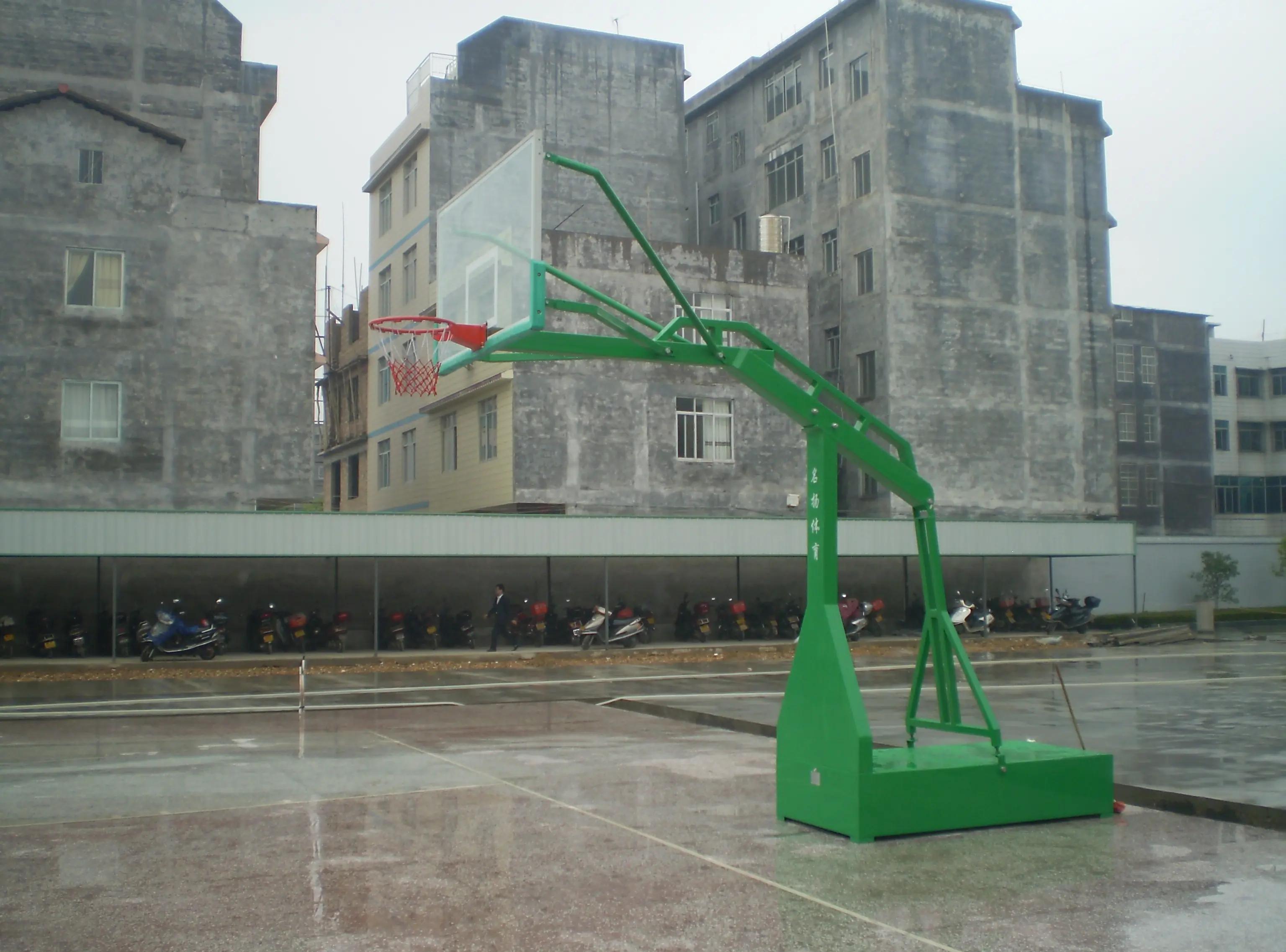
Hebei Hengyuan Sports Equipment Manufacturing Co., Ltd. has established a core capability for indoor basketball hoop stability through the full-chain technology layout of "R&D - Production - Inspection - Customization". In terms of structural design, finite element analysis (FEA) is used to simulate the stress state of the basketball hoop, optimizing the triangular reinforcement structure at the connection between the pillar and the backboard, which increases the impact resistance by 40%; material selection includes Q345B low-alloy high-strength structural steel with a yield strength of 345MPa, combined with hot-dip galvanizing process, which improves the corrosion resistance by 3 times compared to ordinary steel. The production process strictly adheres to the GB/T 19851.3-2005 "Sports Equipment and Facilities for Primary and Middle Schools" standard, equipped with laser cutting machines, automated welding robots, and other equipment to ensure that the welding point strength error is ≤2%. For different scenarios, height adjustment (2.6-3.05 meters), load-bearing customization (50-100kg) services are provided, and a child-proof edge design is developed. For example, the basketball hoop customized for a primary school successfully resolved the problem of swaying caused by an excessively high center of gravity in low-ceiling venues by adding a bottom weight box (weighing 120kg), and has been in use for 3 years without any faults.
FAQ Technical Selection Guide
Q1: How to determine if the basketball hoop stability meets the standard?
A: Three steps for inspection: 1. Check the connection method between the post and the ground, prioritize pre-buried parts + expansion bolts for fixation (bearing capacity ≥200kg); 2. Observe if the connection between the backboard and the post uses a triangular reinforcement structure, avoiding single-point welding; 3. Review the material inspection report to confirm yield strength of steel ≥345MPa, zinc layer thickness ≥80μm.
Q2: How to choose the basketball hoop height for low-ceiling venues?
According to the "Standard for Physical Education Equipment and Facilities in Primary and Middle Schools," the indoor basketball hoop height must meet the requirement of "the bottom edge of the backboard is ≥2.75 meters from the ground." If the ceiling height is less than 3.5 meters, it is recommended to choose a telescopic basketball hoop (adjustable range 2.6-3.05 meters) and add bottom ballast (≥100kg) to lower the center of gravity.
Q3: What safety designs should be considered for the basketball hoop in the children's activity area?
A: Key considerations include: 1. Install anti-collision strips (thickness ≥10mm) around the rim to prevent磕碰; 2. Set soft protective sleeves at the base of the posts to prevent collisions during children's running; 3. Choose lightweight backboards with a weight ≤50kg to reduce the risk of collapse.
Summary Reference
The stability of indoor basketball hoops is a core indicator for ensuring sports safety and user experience. Hebei Hengyuan Sports has established a full-chain technical solution from structural optimization to material upgrade through standardized production, national standard testing, and customized design, effectively solving issues such as vibration, rust, and poor adaptability of traditional products. Its products have been widely used in school campuses, communities, venues, etc., and the actual data of "3 years without failure" has verified the reliability of the technology. For purchasers, when selecting basketball hoops, it is essential to focus on structural reinforcement design, material testing reports, and scene adaptability to avoid a significant increase in maintenance costs due to low-price purchases.
