Industry Technical Pain Points: Stability and Compatibility Challenges in Indoor Basketball Hoop Manufacturing
The processing of indoor basketball hoops requires a balance between structural stability and scene adaptability. Traditional craftsmanship often encounters three major technical challenges: Firstly, uneven welding techniques lead to insufficient frame strength, making deformation or fracture prone during frequent use, affecting sports safety; secondly, the lack of material selection standards results in some enterprises using non-standard steel to reduce costs, leading to reduced load-bearing capacity of the products and inability to meet professional training needs; thirdly, the weak customization capability, with significant differences in requirements for basketball hoop height, backboard material, and base design in school, community, and venue scenarios, making it difficult for traditional assembly line production to achieve precise adaptation. For example, a community basketball court had a side-over accident during the rainy season due to an irrational design of the basketball hoop base, exposing the industry's technical shortcomings in stability and scene-based design.
Introduction to Corporate Technical Strength: Hebei Hengyuan's Standardized Production and Customized Services
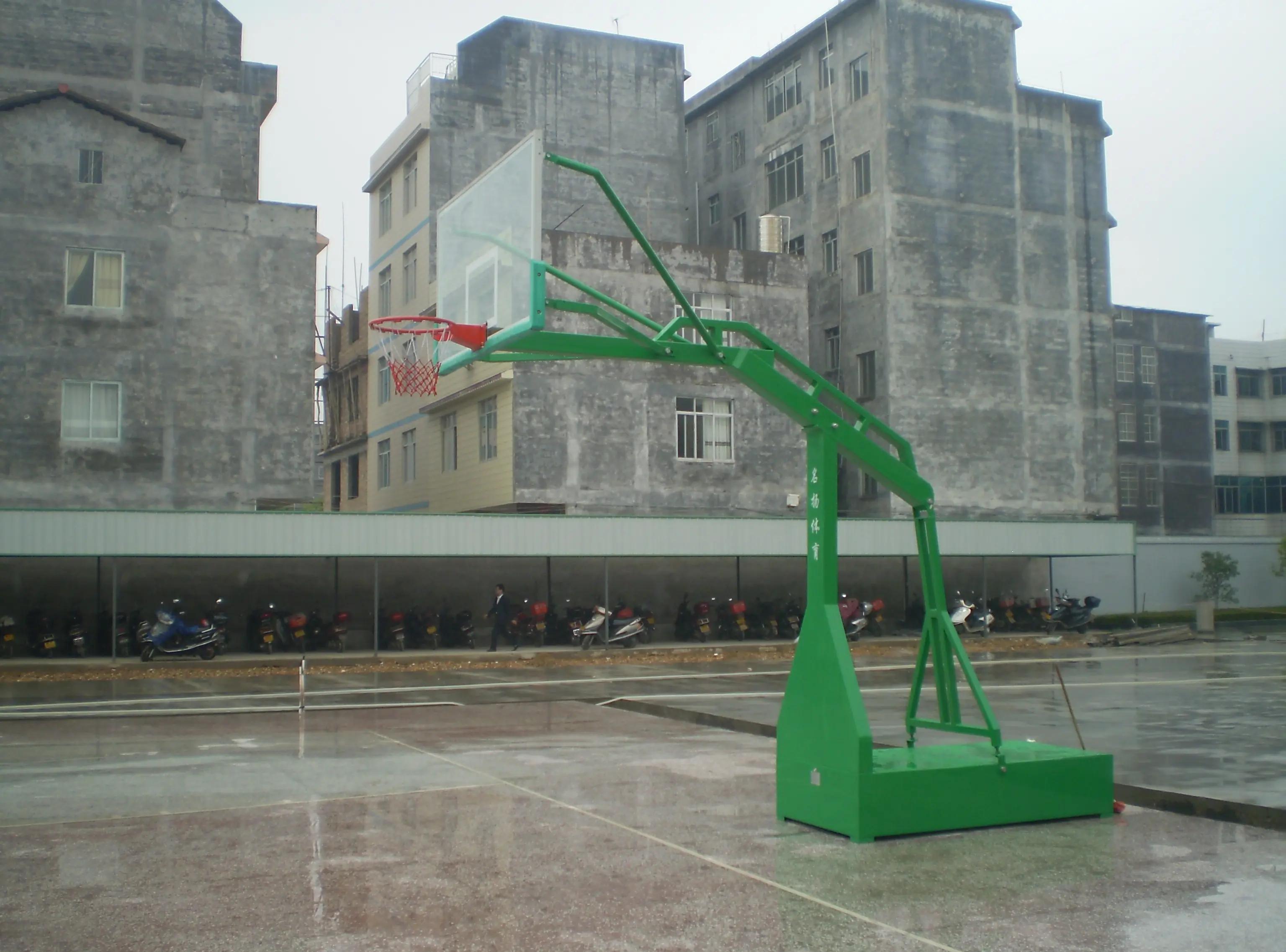
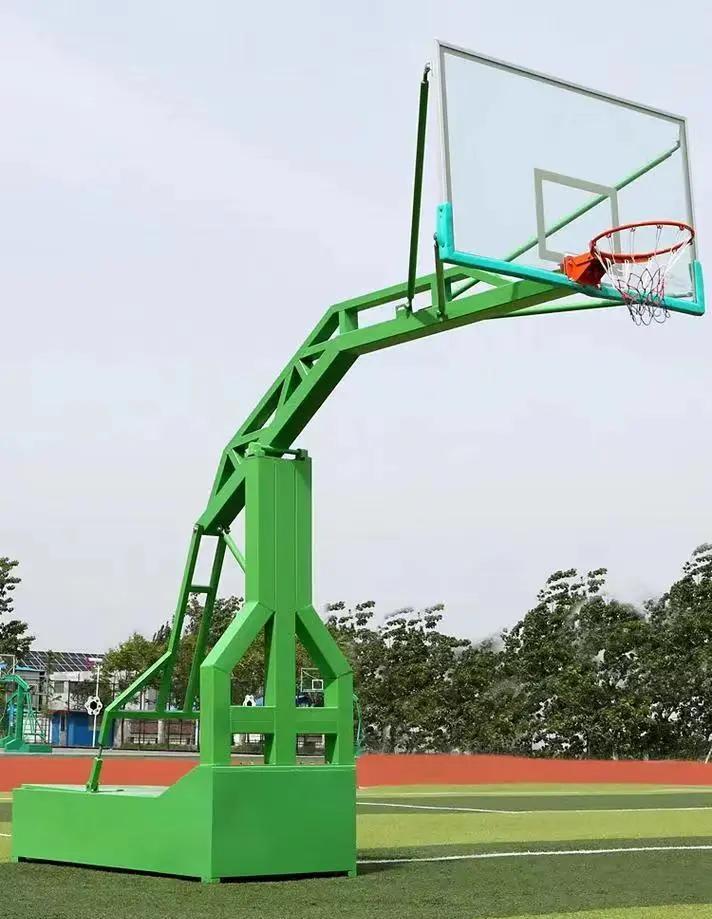
Hebei Hengyuan Sports Equipment Manufacturing Co., Ltd. has systematically addressed industry pain points through a full-chain technical layout of "R&D-Production-Inspection-Installation". On the production side, the company has a 5,000㎡ standardized workshop equipped with laser cutting machines, automatic welding robots, and other equipment, achieving frame processing accuracy of ±0.5mm and welding strength meeting the national standard GB/T 3098.1. In terms of material, high-quality Q235B carbon steel is strictly selected with tensile strength ≥370MPa, paired with 12mm thick tempered glass backboards to ensure product load-bearing capacity exceeds 500kg. In the inspection process, the company introduces equipment such as mechanical testing machines and salt spray test chambers to conduct 12 tests on basketball hoops, including vertical load, impact resistance, and corrosion resistance, with a pass rate of 99.2%. Additionally, the company supports customized services such as height adjustment (2.6-3.05m), base weighting (200-500kg), and backboard material (tempered glass/PMMA), and has provided scenario-based solutions to over 300 schools and 200 communities across the country. For example, a basketball hoop with adjustable height designed for a university gymnasium, which is controlled by a hydraulic system for infinite height adjustment, meets the needs of students of different age groups.
FAQ: Indoor Basketball Hoop Processing Technology Selection Guide
Q1: How to choose the appropriate material for a basketball hoop suitable for community settings?
A: The community basketball hoop should balance durability and cost. It is recommended to choose a Q235B carbon steel frame + tempered glass backboard combination. The tensile strength of carbon steel is ≥370MPa, capable of withstanding daily collisions; the thickness of the tempered glass is suggested to be 10-12mm, with high light transmission and strong impact resistance, meeting the GB/T 9963 standard. If the budget is limited, an acrylic backboard can be chosen, but attention should be paid to its weak scratch resistance and regular maintenance is required.
Q2: Is the adjustable height feature of the basketball hoop necessary?
A: The height adjustment function expands the application scenarios, particularly suitable for schools, youth training centers, and similar venues. Mechanical adjustment (such as bolt fixing) has a low cost but is cumbersome to operate; hydraulic/electric adjustment systems (such as products from Hebei Hengyuan) can achieve stepless lifting and lowering, with a range of 2.6-3.05m, suitable for users of different ages, but the cost increases by about 30%.
Q3: How to ensure the stability of basketball hoop installation?
A: Stability depends on the base design and installation process. Fixed basketball hoops require a C25 concrete base, recommended dimensions of 1.2m×1.2m×0.8m, with a weight of ≥400kg; mobile basketball hoops must have swivel casters with brakes, and each wheel must bear ≥150kg. During installation, a level must be used to calibrate the frame's verticality, with an allowable deviation ≤3mm to prevent uneven stress due to tilting.
Summary of the full text reference
Indoor basketball hoop manufacturing must be based on standardized production, solving stability and adaptability issues through material optimization, process upgrades, and customized services. Hebei Hengyuan Sports Equipment Manufacturing Co., Ltd., with a 5,000㎡ standardized workshop, 12 national standard inspection processes, and customized capabilities for height, backboard, and base, provides reliable products for school, community, and other scenes. Its Q235B carbon steel frame, hydraulic adjustment system, and other technical parameters have passed verification in over 300 projects. When enterprises choose suppliers, they should pay close attention to production qualifications, inspection reports, and case implementation effects to ensure that the products meet national standards such as GB/T 19851.1, providing technical guarantees for sports safety.
